

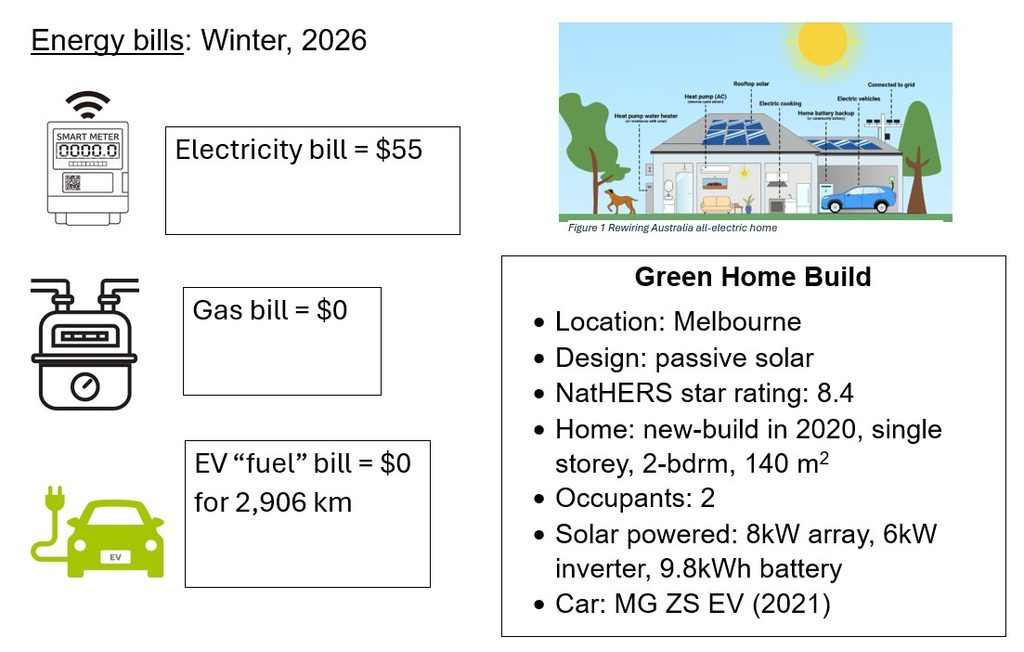
During Winter, I paid just $55 to power my Ringwood East home and electric vehicle. The recipe for this success has several ingredients.
Look for a competitive energy retailer plan
Use the Victorian Energy Compare website to search for a competitive electricity plan.
According to the ACCC, three quarters of Aussie homes aren’t using the best offer plan from their current retailer. Swapping to the best offer will immediately save money.
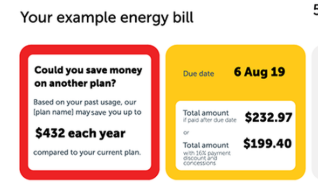
Occasionally looking for the latest deals from other retailers could save even more money on the monthly energy bill.
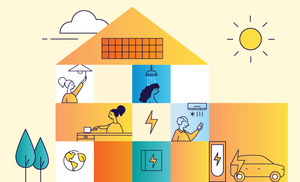
Aim for an all-electric, efficient home
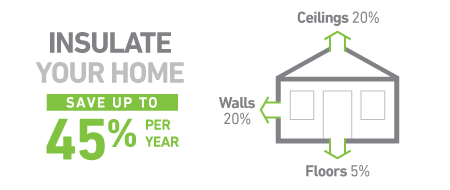
Now look at making the home more efficient. An efficient home uses less energy from mechanical heating to keep indoors warm. Wrapping the home with a good layer of insulation reduces expensive heat transfer from indoors to outdoors. Draughtproofing also eliminates those sneaky breezes which leak heat out of the home.
Next, begin switching to electrical appliances. Reverse cycle air conditioners are an efficient way to heat the home in Winter and have the added benefit of cooling indoors during Summer. Hot water heat pumps use the same air conditioner technology to put 4 energy units of heat into the hot water tank using only 1 energy unit of electricity.
Easy Electric SEC and Electric Saul are two excellent resources for getting accurate, reliable information about electrifying appliances.
There is a bonus saving for changing all major household appliances to electrical alternatives. Without the gas line, there’s no need to pay the $350+ per year connection fee.
Don’t forget the car. An electric vehicle (EV) doesn’t use expensive petrol/diesel and can be charged at home.
Power the home with solar
Use rooftop solar panels to power the home during the day. The major energy users, heating and hot water, can operate for free using “home grown” solar power.
Add a battery to store excess solar power. The home won’t use expensive grid electricity during the evening peak hours when the sun isn’t shining.
Putting it all together
My all-electric, efficient home uses a GloBird Zero Hero plan for electricity supply from the grid.
Being efficient, the home doesn’t require a large amount of energy to keep indoors warm. The hot water heat pump is programmed to operate during the day when it’s likely to be powered by solar panels.
Being at home during most days, I take advantage of the three free hours of power in the Zero Hero plan. Between 11am and 2pm, I charge the EV, recharge the home battery, run the hot water heat pump, etc. Any electricity taken from the grid is free.
Fully recharging the home battery for free means it’s always available to power the home during the evening peak time. That’s when electricity is most expensive.
The GloBird plan has a neat way of encouraging customers to avoid using grid electricity during peak time. They pay a credit of $1 every day when the customer uses their battery, instead of grid electricity, between 6 and 9pm.
So, it costs $1.50 per day to be connected to the electricity grid. Subtract the $1 daily credit and the fixed cost drops to 50c per day. But the all-electric, efficient home uses hardly any electricity outside the free time. Paying for a small amount of imported electricity bumps up the average daily cost for powering the home and car to 60c.
There it is; a Winter energy bill of $55.
What can you achieve?
If you’re thinking about cutting your household energy bills, I recommend considering this recipe.
Which ingredients do you already have? What missing ingredient would be worthwhile adding to cut existing bills?
Remember, it’s a journey. Everything helps, but everything doesn’t have to be done at once.